 3T Consults and Coaching
HL7 Messaging
Receive, log, edit and deliver HL7 with retries, ACK checks and a searchable record.
MLLP listeners that store and acknowledge every HL7 message, and a delivery queue that retries until the receiver accepts. Field Editor rules fix messages on the way in or out, message templates check what each interface really sends, and every message can be searched, read and resent.
The challenge
When a result never reaches the RIS or an order never reaches radiology, the first question is always "did we send it, and what came back?" Too often the answer sits in an interface engine log that radiology cannot see, or nowhere at all.
Receivers go down overnight, reject a message for a missing field, or expect a different MSH-5. Without a queue that retries, a record of every attempt and a way to fix and resend, each of those becomes a manual hunt and a phone call.
What it does
Listeners that keep everything
MLLP listeners on any port store each message (any v2.x version), index its header, patient, visit and order fields, and answer with an ACK that echoes the sender.
Honest acknowledgements
AA only when the message parsed and was saved; AE with the reason when it did not, so the sender knows to keep it.
Type filters
Accept only the message types and triggers you want (ADT, ORM, ADT^A08); anything else is answered "ignored" so the sending engine never stalls.
A delivery queue that retries
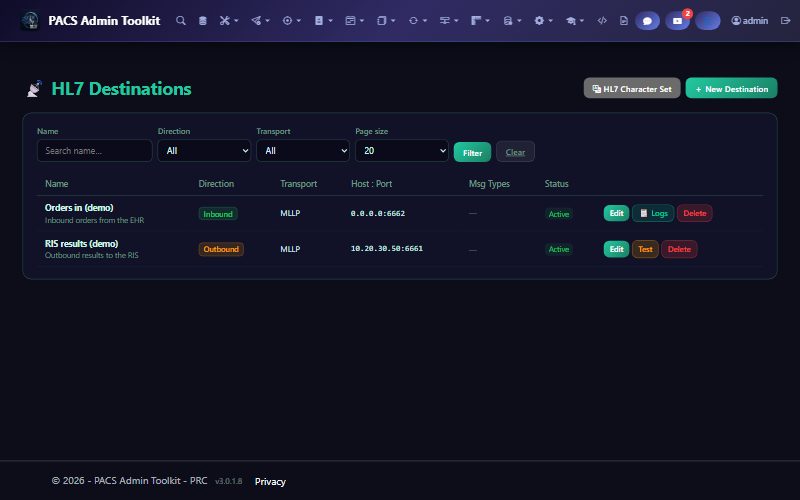
Outbound messages are queued per destination with priorities, worker threads, retry counts and delays, and survive a restart.
ACK rules per receiver
Each destination decides what counts as delivered: AA only, AA or CA, any response, or fire and forget.
Field Editor rules
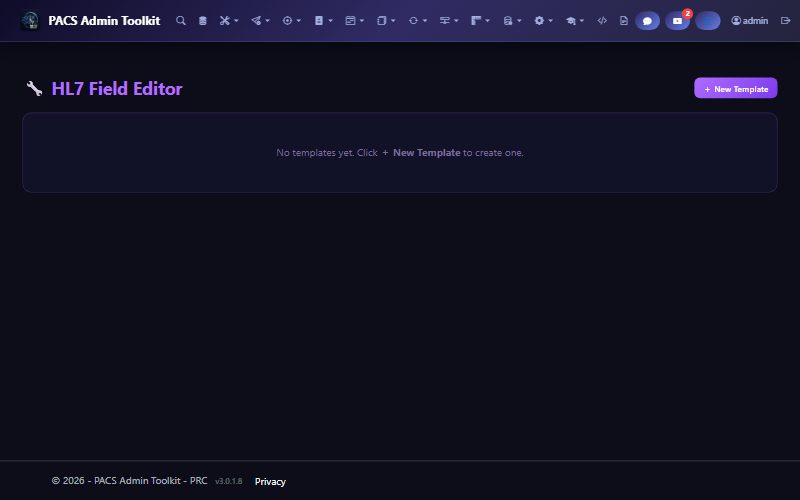
Fix fields and segments on inbound messages before they are stored, or on outbound messages just before they are sent: copy, set, pad, trim, split, find and replace, map codes, reformat dates, add, delete or blank segments, drop messages that match (a NO READ report), take the first field that has a value or work out an age, each rule built from plain steps with optional conditions, picking fields by name or by a value seen in the test message. With De-identification, the same rules replace identifiers with crosswalk surrogates and match results back.
Recipes, lookup tables and a live test
Start from ready-made rules (fill a missing MRN issuer, translate patient class, blank the SSN), translate codes through lookup tables of thousands of rows pasted from a spreadsheet, and see each step's result on a real message before a rule touches traffic.
Message templates that check interfaces
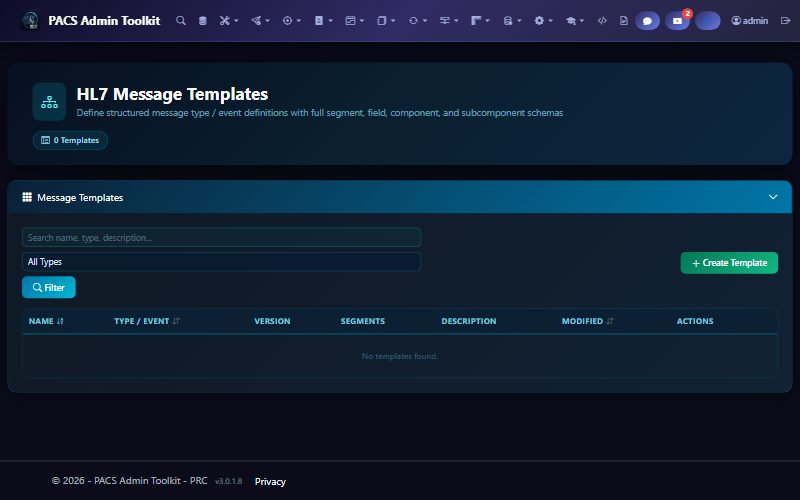
Describe a message type from built-in ADT, ORM, OMI, ORU, SIU, MDM and DFT examples or from a real message, then paste messages to see missing required fields, wrong lengths, bad dates and unexpected segments.
Worth a look and recent messages
Findings from live messages show listeners failing or filtering, a new sending application, a feed gone quiet and Field Editor rules that fail or never change anything; a draft template is run over the newest stored messages before it is saved.
Listener safeguards
Limit each listener to known sender addresses and sending applications, cap message size and connections, and close idle connections, all set with plain fields and tips.
Search, read and resend
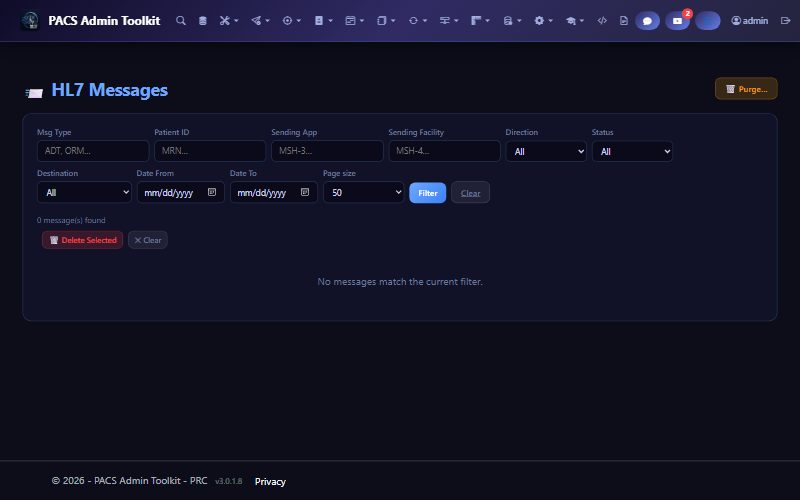
Filter by type, patient ID, sending application, direction, status and date; read any message field by field; resend it to one or more destinations, edited if needed.
Paste and send by hand
Paste a raw message from anywhere, see it parsed live with every field named, fix a value, give it a fresh control ID and send it to one or more destinations; each send shows the receiver's ACK and is logged with who sent it.
Reprocess after an outage
Failed batches go back to the queue with retries reset, oldest first, with urgent ones set to Expedited.
How it works
- Message arrives. The EHR, RIS or interface engine connects to a listener port over MLLP.
- Filtered and edited. The type filter and any assigned Field Editor rules apply.
- Stored and acknowledged. The message is parsed, indexed in HL7 Messages and answered AA or AE.
- Outbound queued. Messages built by DICOM to HL7 join the queue, one item per destination.
- Delivered and checked. Each item is sent over MLLP, the ACK is read, and it is marked Sent or retried.
Use cases
Radiology needs to see what the EHR sends
Challenge. Orders and patient updates go missing between the EHR and radiology, and only the interface team can look at the traffic.
With PATK. The interface engine adds a copy feed of ADT and ORM to a PATK listener; radiology IT searches by MRN and reads PID and PV1 field by field.
Outcome. "Was it sent?" is answered in a minute by the people who asked, without a ticket to another team.
Results receiver down overnight
Challenge. The RIS interface restarted at 2 a.m. and every result sent meanwhile failed.
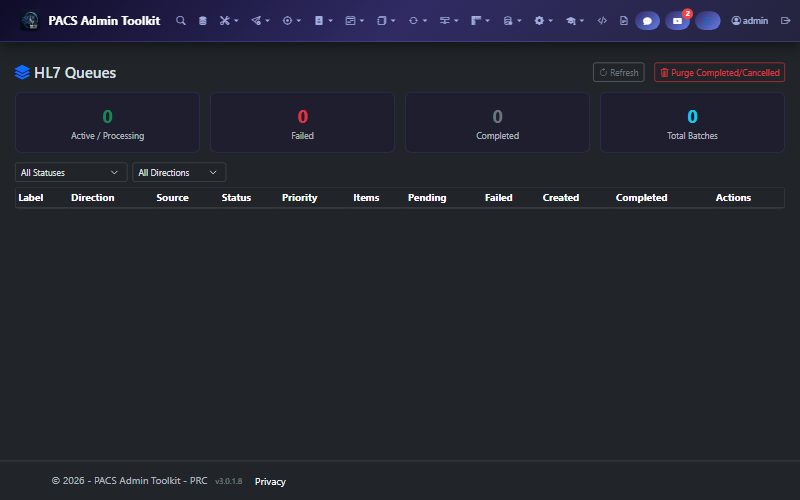
With PATK. Failed batches stay in HL7 Queues with the reason; once the receiver is back, Reprocess sends them oldest first, urgent ones Expedited.
Outcome. No results re-keyed and none lost; a longer retry delay rides out the next outage on its own.
Two receivers, two conventions
Challenge. The RIS and the billing system want the same results with different MSH-5 values and a reformatted date.
With PATK. Each destination carries its own MSH settings and Field Editor template; each gets its own queue item and retries.
Outcome. One feed serves both, and a failure at one receiver never holds up the other.
Trust · Truth · Transform
Trust
Messages are kept before they are acknowledged, the queue survives restarts, and a scheduled or in-flight item is never sent twice; purges need Delete and Purge permissions.
Truth
Every message, ACK, send attempt and error is recorded and searchable, with each listener's live log beside it.
Transform
Fixing a field, re-pointing a receiver or replaying an outage takes minutes in the browser instead of an interface change request.
Value model
An example radiology department that today relies on an interface team for HL7 visibility and redelivery.
| Assumption | Example value |
|---|---|
| HL7 questions investigated per month ("was it sent, what came back") | 30 |
| Time saved per investigation with a searchable log | 30 minutes |
| Receiver outages per year | 6 |
| Messages to re-send or re-key by hand per outage | 200 at 3 minutes each |
| Blended IT / interface analyst cost per hour | $60 |
| Avoided interface engine channel licensing or build for logging and delivery | $10,000 |
| Estimated yearly value | $24,400 |
Illustrative only: every assumption is shown so you can replace it with your own numbers. Your results will differ.
Why it stands out
- Built for the radiology team. The log, queue and resend live in the same product as routing and worklist, not in an interface engine only the integration team can open.
- Delivery you can prove. Each attempt, ACK code and error is kept with the message, which simple MLLP senders and scripts do not record.
- Edits without code. Field Editor rules and lookup tables replace one-off scripts and are tested step by step on a real message before they touch traffic.
- Multi-site aware. With Access Topology, each user sees only their units' messages and a destination can accept only its own unit's data.
At a glance
| Standards | HL7 v2.x over MLLP, with ACK (AA / AE / AR, enhanced CA / CE / CR) |
|---|---|
| Inbound | Listeners on any port, message type filter, allowed senders and applications, size / connection / idle limits, store and ACK switches |
| Outbound | Queue with priorities, worker threads, retries, retry delay, connect and ACK timeouts, accept mode, MSH fill or overwrite |
| Tools | Field Editor templates with recipes and lookup tables, message templates with a message checker, Test Connection, Resend, live listener logs |
| Housekeeping | Purge by status and age, purge completed / cancelled batches, UTF-8 or ASCII character set |
Screenshots
More in Platform & Integration
Core Platform
Sign-in, security, audit, help and setup that every PATK installation includes.
SFTP Transfers
Partner files collected on schedule, landed safely, and logged, with nobody logging in to fetch them.
PostgreSQL Admin
Keep the database behind a 24/7 imaging service healthy, backed up and explainable, without a full-time DBA.
External API
Keys for every system that calls PATK, and a clear view of what each one actually does.
Messenger
Real-time chat, group chats, presence and study links for everyone who works in PATK.
De-identification
Send studies and reports out under stable surrogates, and match the results back to the right patient.
Integration Engine
Channels that receive, filter, transform and route HL7 and DICOM to many destinations, built on the endpoints you already run.
Master Patient Index
Recognise one patient across facilities, IDs and systems, with the confidence and the reasons shown.
Not a medical device. PACS Admin Toolkit is not FDA-cleared or CE-marked and is not intended for primary diagnosis. It manages imaging and reporting data and workflows around the clinical systems that do.
Other product and company names may be trademarks of their respective owners. Screenshots show sample data. Value models are illustrative estimates, not guarantees.