 3T Consults and Coaching
De-identification
Send studies and reports out under stable surrogates, and match the results back to the right patient.
Crosswalk tables give every patient, accession and physician one stable surrogate, created atomically so two messages for a new patient never get two. Results that come back are matched to the real values only when exactly one row fits, and every re-identification is audited.
The challenge
Research partners, AI vendors and teaching files need imaging without patient identity, but the results they send back have to land on the right patient. That needs a crosswalk: a table pairing each real identifier with a surrogate.
Crosswalks are usually built inside interface-engine scripts. Two messages for a new patient can create two surrogates, a missing index slows every message, a lookup that matches two rows silently picks one, and nobody can say who looked up a real identity or why.
What it does
Crosswalks you can see
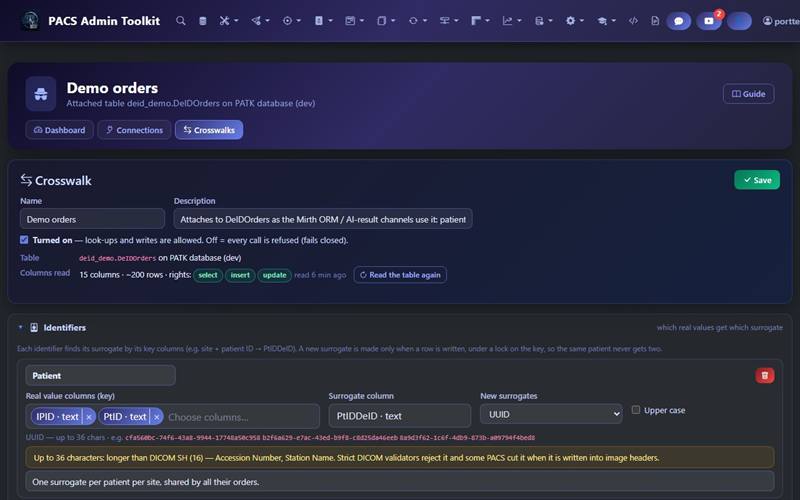
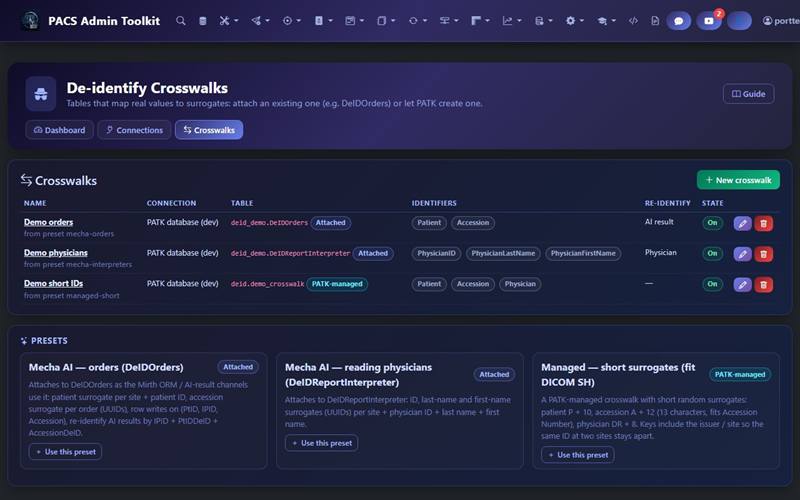
Attach an existing crosswalk table or let PATK create one; map which columns hold the real values and which hold the surrogates.
One surrogate per value
New surrogates are created under a lock on the real key (or by unique indexes on a PATK-managed table), so concurrent first messages always share one.
Surrogates that fit
UUIDs, keyed hashes, prefixed random patterns, counters or fake names, with warnings when a value is too long for the DICOM field it goes into.
Safe row writes
An upsert by the table's unique key, with a rule per column: overwrite, keep the first value, fill only if empty or never touch. Existing surrogates are never replaced, and a write that changes nothing leaves the row alone.
Re-identification that refuses to guess
A match names the de-identified columns that must find exactly one row; two rows means refused, not picked.
Index advice
Checks that every lookup has an index and suggests concurrent builds and redundant indexes to drop, with a script for a DBA.
Secure connections
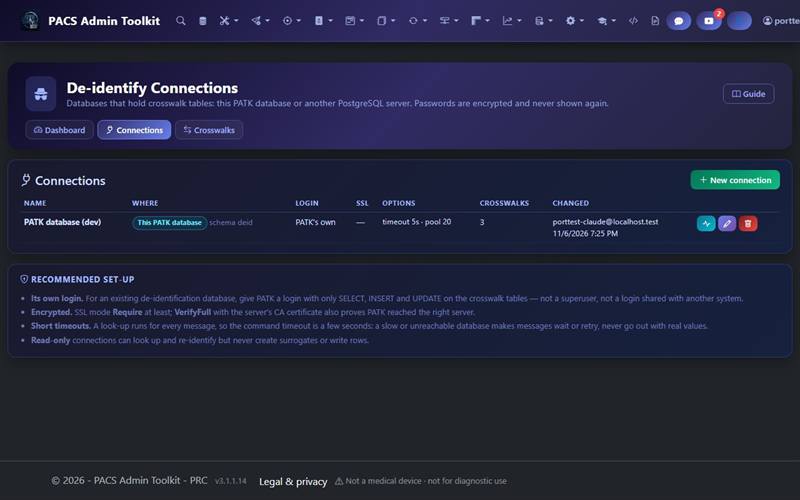
Encrypted passwords, SSL, short timeouts and read-only connections for sites that only re-identify.
A bench to try it
De-identify a value, dry-run a row write or re-identify with a reason, before the crosswalk is turned on.
Presets for existing tables
Ready-made settings for common order and physician crosswalk tables, including physicians keyed by site so the same name at two sites stays two people.
De-identify inside the rules you already use
De-identify, Re-identify and Capture steps in the HL7 Field Editor and the DICOM Tag Editor: an order goes out with surrogates, the study's images get the same patient surrogate, and an AI result comes back with the real IDs.
Held, never leaked
A step that can't de-identify holds the message (an HL7 sender gets a negative ACK and resends; a DICOM image is refused), a PHI leak guard holds anything that still contains a value a step replaced, and a surrogate too long for a DICOM tag is refused instead of being cut.
Filter and trim what goes out
Drop messages that match (a NO READ report), blank a segment except the fields named, and delete report lines that contain any of a list of phrases.
Tests that don't reveal or write
Rule tests look surrogates up without creating any, and mask real values for users without the re-identify permission.
Profiles instead of hand-written rules
Tick what is replaced, emptied, shifted or removed (patient identity, demographics, order, providers, dates, free text, PS3.15 attributes), preview the result on a sample, and compile it into an HL7 Field Editor or DICOM Tag Editor template. Re-identify profiles restore results from a match of de-identified columns.
A field map for the crosswalk row
Each table column with its type and length next to the message value that fills it, tested with a rolled-back write.
Bring an existing crosswalk along
Load an export of any size from CSV or Excel; existing surrogates are kept as they are, conflicts are counted and left out, and a failed load changes nothing.
Whole files in one go
De-identify the columns of a spreadsheet for a research partner, or re-identify a returned file with a reason on record.
A review queue for early results
A result that arrives before its order reached the crosswalk is acknowledged, kept encrypted and retried until its row appears, then failed or passed after a hold time you set.
Look-ups with a paper trail
Find a surrogate, or re-identify one with a reason; every look-up is audited and counted.
People whose details change
When a last name or a patient ID changes, a key alias keeps the same surrogate for the new values; re-identify gives back the original, the newest or a preferred key, or stops for a person to decide.
Point and pick, not variable names
Every "which message value goes here" box suggests the likely HL7 field or DICOM attribute for each key and opens a searchable list of all of them, so nobody needs to know placeholder syntax.
Ready-made packs
Load a complete setup for an AI vendor, a research export, a teleradiology service or a teaching file, or bring your own exported pack. Crosswalks arrive switched off and profiles uncompiled, so nothing runs until it has been checked.
Compare before you switch
Run recorded interface-engine traffic through the new rules, read-only, and see field by field where the output would differ before a channel is moved.
Files that arrive on their own
Watch a folder, a share or an SFTP / FTPS server: each new file is de-identified or re-identified and delivered, the source moved aside, and no file taken twice.
A data API with limits
Let a research team or an AI vendor query just the columns, rows and look-ups an administrator allows, with an API key or token, daily limits and every call audited.
How it works
- Connect. Add the database that holds the crosswalk, or use PATK's own.
- Describe. Attach the table (or let PATK create one) and map identifiers, keys and surrogate columns.
- Check. Build the suggested indexes and try look-ups, dry-run writes and re-identification with test values.
- Add the steps. Put De-identify (and Capture) steps in the outbound HL7 and DICOM templates, and Re-identify in the template on the listener that receives results; each editor's Test tab shows the outcome as a dry run.
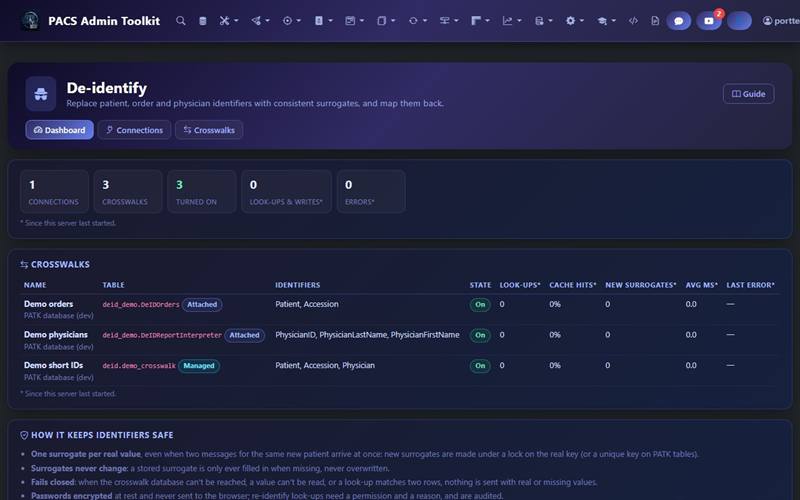
- Turn on. Look-ups are cached; new surrogates are created atomically; every refusal is counted on the dashboard.
- Match back. Results are re-identified only when exactly one row fits, with the reason in the audit log.
Use cases
Studies to an AI vendor and results back
Challenge. An imaging group sends studies to an AI vendor under surrogate patient IDs and accessions; results return with only the surrogates.
With PATK. The order crosswalk gives each patient and accession a surrogate on the first order; the AI-result match finds the one row by site, patient and accession surrogates and returns the real values.
Outcome. Results land on the right study, and a result that matches two rows waits for a person instead of landing on the wrong patient.
Taking over a crosswalk from an interface engine
Challenge. A hospital network's crosswalk tables were filled by engine scripts for years; the network wants to retire the scripts without re-keying anyone.
With PATK. The existing tables are attached as they are; PATK reads the surrogates already there, fills new rows by the same keys and suggests the indexes the tables lacked.
Outcome. Every existing patient keeps their surrogate, and the switch-over is a settings change rather than a data migration.
A research export with short surrogates
Challenge. A research team needs patient and accession surrogates short enough for DICOM fields that hold 16 characters.
With PATK. A PATK-managed crosswalk with prefixed counters (P, A, DR) and unique indexes on both directions.
Outcome. Surrogates fit every field, can never collide, and stay the same for the same patient across exports.
Trust · Truth · Transform
Trust
Surrogates are created atomically, lookups fail closed and re-identification needs a permission and a reason.
Truth
The dashboard counts lookups, new surrogates, writes and errors per crosswalk; the audit log records every change and every re-identification.
Transform
Crosswalks that lived in engine scripts become settings that can be read, checked and tested in the browser.
Value model
An example imaging group sending studies to an AI vendor and matching results back.
| Assumption | Example value |
|---|---|
| Studies de-identified and matched back per year | 40,000 |
| Results needing manual matching without an exact crosswalk match | 0.5% (200) at 15 minutes each |
| Interface-engine script maintenance avoided per year | 40 hours |
| Blended staff cost per hour | $60 |
| Duplicate surrogates found and fixed by hand per year without atomic creation | 50 at 30 minutes each |
| Estimated yearly value | $6,900 |
Illustrative only: every assumption is shown so you can replace it with your own numbers. Your results will differ.
Why it stands out
- Concurrency handled. Surrogate creation is locked on the real key; it was tested with a hundred simultaneous first messages producing one surrogate.
- Refuses rather than guesses. Ambiguous matches, missing indexes and unreachable databases are reported, not worked around.
- Works with the tables you have. Existing crosswalks are attached without changing their structure.
- Same platform. Connections, audit and permissions sit alongside routing, HL7 and DICOM tools.
At a glance
| Databases | PostgreSQL (another server or PATK's own, schema deid); SSL Require / VerifyCA / VerifyFull |
|---|---|
| Identifiers | Any number per crosswalk, keyed on one or more columns (site, patient ID, accession, names) |
| Surrogates | UUID, keyed hash (HMAC-SHA256), prefixed random pattern, counter, fake name |
| Controls | Upsert key, per-column write rules, re-identify matches, read-only connections, crosswalk on / off |
| Tools | Index advice with concurrent build / drop, try-it bench, dashboard counters, audit log |
| Rule steps | De-identify, Re-identify, Capture (HL7 Field Editor and DICOM Tag Editor); HL7 Drop message, Blank all fields except, contains any of; PHI leak guard |
| Profiles | Checklists for HL7 and DICOM, de-identify and re-identify, compiled into editor templates; capture field map; before / after preview |
| Packs | Five ready-made packs (AI vendor orders / reports / results, research DICOM export, generic AI vendor, teleradiology, teaching file); import and export |
| Parity check | Recorded interface-engine message exports compared field by field with what PATK would send; read-only; ignore list |
| Folder pick-up | Watched folders on the server, a share, or an SFTP / FTPS server; each new file de-identified or re-identified and delivered; never taken twice |
| Data API | Data sets outside systems query with an API key or token: chosen columns, required and fixed filters, rows per call and per day, allowed callers and networks; every call audited |
| Master Patient Index | With the MPI toolset: patient surrogates keyed by MPI ID (one surrogate per person, Exact and Confirmed links only) and re-identify to the person's ID for a chosen issuer |
Screenshots
More in Platform & Integration
Core Platform
Sign-in, security, audit, help and setup that every PATK installation includes.
HL7 Messaging
Receive, log, edit and deliver HL7 with retries, ACK checks and a searchable record.
SFTP Transfers
Partner files collected on schedule, landed safely, and logged, with nobody logging in to fetch them.
PostgreSQL Admin
Keep the database behind a 24/7 imaging service healthy, backed up and explainable, without a full-time DBA.
External API
Keys for every system that calls PATK, and a clear view of what each one actually does.
Messenger
Real-time chat, group chats, presence and study links for everyone who works in PATK.
Integration Engine
Channels that receive, filter, transform and route HL7 and DICOM to many destinations, built on the endpoints you already run.
Master Patient Index
Recognise one patient across facilities, IDs and systems, with the confidence and the reasons shown.
Not a medical device. PACS Admin Toolkit is not FDA-cleared or CE-marked and is not intended for primary diagnosis. It manages imaging and reporting data and workflows around the clinical systems that do.
Other product and company names may be trademarks of their respective owners. Screenshots show sample data. Value models are illustrative estimates, not guarantees.