 3T Consults and Coaching
Study Retention Policies
Keep what the law and your records officer require, release the rest, and prove it.
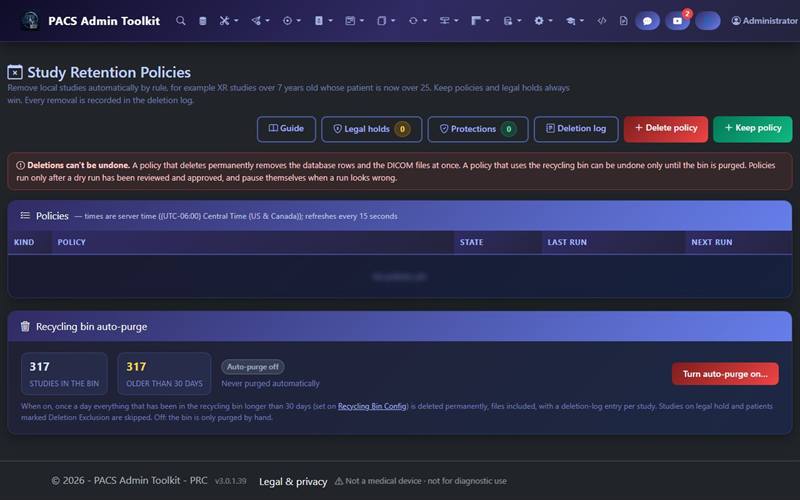
Scheduled delete and keep policies for the studies stored in PATK, with dry runs, typed approval and safety stops. Legal holds, protections and a permanent deletion log show exactly what was kept, what went and why.
The challenge
Cache, edge and routing servers fill up. Someone has to decide what to delete, and in radiology that decision is never simple: adult studies, minors until they reach a set age, mammography for ten years, a litigation hold on one patient, a temporary site that should be cleared after six months. Getting it wrong either way is expensive: a full disk stops clinical traffic, and a study deleted too early can be a records or legal problem.
Most sites handle it with a script someone wrote years ago, or a manual purge that nobody wants to own. There is no preview of what will go, no brake if the numbers look wrong, and no record a records officer can sign off on.
What it does
Rules your records officer can read
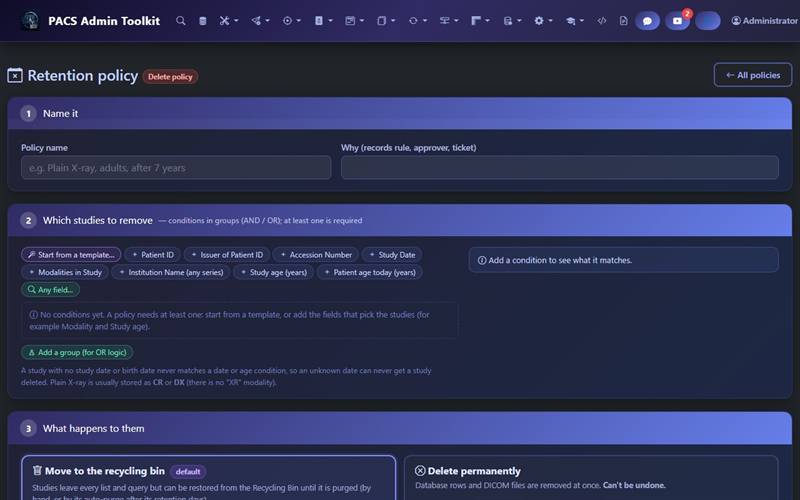
Conditions on patient, study and series fields plus calculated values (study age, patient age today, patient age at the study, days since received), in AND / OR groups.
Templates for common schedules
Start from adults after 7 years with minors kept until 25, plain X-ray after 7 years, mammography after 10, one issuer after 6 months, one site after 7 years, or a list of accession numbers.
Keep policies that always win
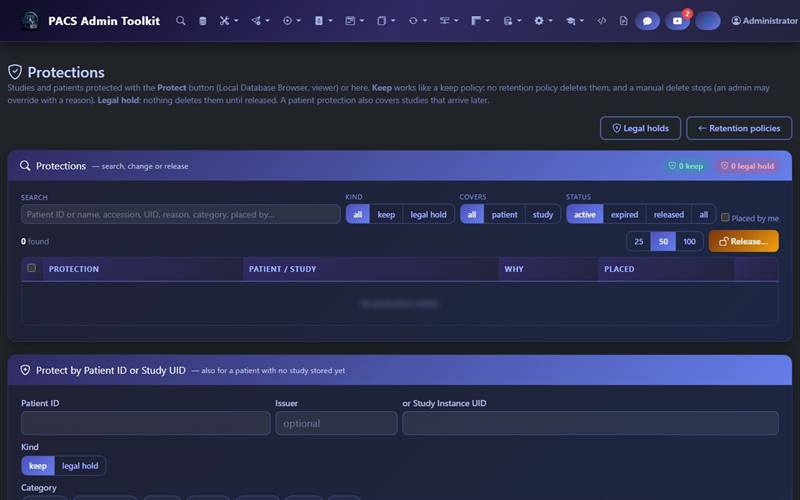
A keep policy (for example all mammography for 10 years, or patients under 18) protects matching studies from every delete policy.
Dry run, then a typed approval
A dry run counts what matches, what each hold keeps back and what would go, lists the oldest 100 and exports the full list; approval needs a dedicated permission and the policy name typed in.
Safety stops built in
A per-run cap (default 500, oldest first), a pause when a run would remove more than a set share of all studies, a pause when the count jumps sharply since last time, and recent arrivals (default 30 days) never touched, so imported priors with old dates are safe.
Legal holds and protections
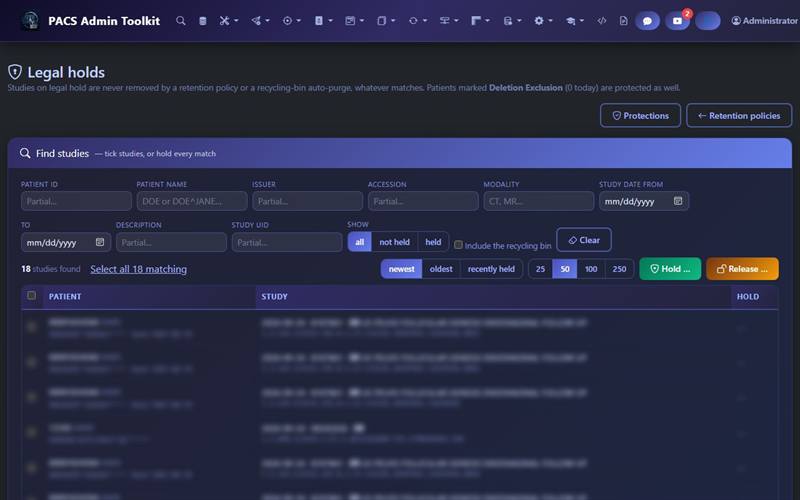
Hold studies by search, by pasted list (up to 1,000,000 UIDs) or by patient; protect one study or a whole patient from the browser or viewer with a category, a reason and an end date.
Manual deletes obey the same rules
Deleting by hand checks holds, keep policies and Deletion Exclusion patients first; overrides need a reason and are audited, and legal holds are never overridden.
Reversible by default
Policies move studies to the recycling bin unless a user with the permanent-delete permission says otherwise; an optional daily bin auto-purge skips held studies.
A record that lasts
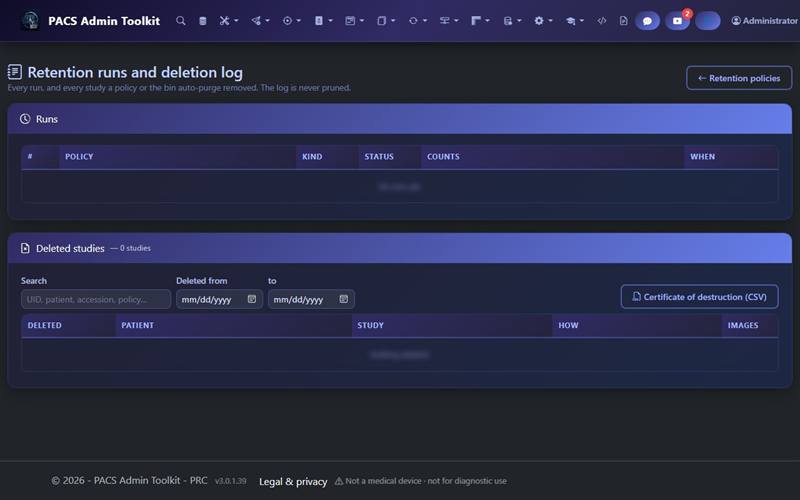
Every removed study gets a deletion-log entry in the same transaction, kept forever and exportable as a certificate of destruction.
How it works
- Write the policy. Conditions, recycle or delete, safety stops and run windows (default 01:00-05:00).
- Holds come out. Legal holds, Deletion Exclusion patients, active bulk updates, recent arrivals and keep policies are set aside.
- Dry run. Counts, the oldest 100 and a full CSV for the records officer.
- Approve. A permitted user types the policy name; any later change switches it off again.
- Runs and logs. The policy runs in its windows, oldest first, pausing itself if numbers look wrong; every study is logged.
Use cases
State retention schedule on a regional cache server
Challenge. The local cache keeps everything forever, and the disk alert fires every quarter. The state requires adults for 7 years and minors until age 25.
With PATK. The adults / minors template becomes a delete policy to the recycling bin, with a keep policy for mammography for 10 years; the records officer signs off the dry-run CSV.
Outcome. Storage growth levels off, the rule is written down where anyone can read it, and every removal is in the log.
Litigation hold on one patient
Challenge. Risk management asks that every study for a patient be preserved, including studies that have not arrived yet.
With PATK. A patient-level legal hold from the browser covers every study of that Patient ID and issuer, now and later; no policy, purge or admin can remove them until the hold is released with a reason.
Outcome. A hold that cannot be bypassed by accident, with placement and release in the audit log.
Clearing a temporary or divested site
Challenge. A mobile unit or a closed clinic sent studies under its own issuer; after six months they should leave the edge server.
With PATK. The one-issuer template removes that issuer's studies older than six months, capped per run and paused automatically if the count looks wrong.
Outcome. The site's data is cleared on schedule, with a certificate of destruction for the file.
Trust · Truth · Transform
Trust
Nothing runs without a dry run and a typed approval; legal holds are checked again inside the delete itself; safety stops pause a policy before a mistake becomes a mass deletion.
Truth
See exactly what a rule would remove before it removes anything, what each hold kept back, and a permanent per-study record of what went, when and under which policy.
Transform
Retention stops being a yearly fire drill: written once, approved once, and run quietly every night inside its window.
Value model
An example edge or cache server that keeps growing until someone purges it by hand.
| Assumption | Example value |
|---|---|
| Storage released per year by retention policies | 40 TB |
| All-in cost of primary storage plus its backup, per TB per year | $300 |
| Administrator time on manual purges avoided | 8 hours a month (96 hours a year) |
| Records and legal requests answered from the deletion log instead of by search | 20 a year, 2 hours saved each |
| Blended staff cost per hour | $55 |
| Estimated yearly value | $19,500 |
Illustrative only: every assumption is shown so you can replace it with your own numbers. Your results will differ.
Why it stands out
- Safer than a purge script. Dry runs, typed approval, per-run caps and automatic pauses are built in, where a script deletes whatever its query returns.
- Holds that really hold. Legal holds win over every policy, every manual delete and the bin purge, and are re-checked at the moment of deletion.
- Proof for the records officer. A permanent deletion log and certificate-of-destruction export, which disk-cleanup tools and scripts do not keep.
- Scoped for multi-site. A policy written by a facility or site user only touches that unit's studies when Access Topology is licensed.
At a glance
| Scope | Studies stored in PATK's own database and files; never other systems |
|---|---|
| Conditions | Patient, study, series and calculated fields; AND / OR groups; lists up to 1,000,000 values; dynamic dates |
| Safety | Per-run cap, share-of-all-studies pause, jump pause, recent-arrival protection, recycling bin by default |
| Protection | Keep policies, legal holds, Protect button (study or patient), Deletion Exclusion patients |
| Record | Deletion log kept forever, certificate of destruction (CSV), audit log for holds and overrides |
| Permissions | Separate approve, permanent delete, release hold, place hold, override and bin auto-purge rights |
Screenshots
More in Data Lifecycle
PACS Migration
Move every study from the old PACS to the new one, fix tags on the way, and prove it arrived.
Local Bulk Updater
Correct patient IDs, issuers and institution names on stored studies, previewed, paced and reversible.
Not a medical device. PACS Admin Toolkit is not FDA-cleared or CE-marked and is not intended for primary diagnosis. It manages imaging and reporting data and workflows around the clinical systems that do.
Other product and company names may be trademarks of their respective owners. Screenshots show sample data. Value models are illustrative estimates, not guarantees.